
Culver City Public Records Inventory
Culver City open records are split across city, county, court, and state offices. The city handles its own correspondence, permits, code files, local police reports, and other municipal records. Los Angeles County keeps the heavier identity-bearing record sets, including recorded real-estate documents, birth, death, and marriage copies, Assessor parcel data, voter administration, fictitious business name filings, and court records through the Superior Court.
| Record Set | Custodian | Online Index | Access |
|---|---|---|---|
| City files, emails, permits, code records | Culver City | NextRequest and permit portal | Portal, email, mail, in person, or department request |
| Deeds, liens, maps, official records | LA County RR/CC Recorder | No official internet real-estate index | Norwalk appointment or counter, mail, and copy request |
| Court cases | Los Angeles Superior Court | Paid online name searches | Paid web search, document image order, courthouse terminals, Archives |
| Parcel and assessment records | LA County Assessor | Assessor Portal and Map Search | Free AIN/address and GIS search; ownership may need request channels |
| Birth, death, marriage copies | LA County RR/CC, DPH, CDPH-VR | Application portals, not a general name index | Authorized or informational certified copies |
| Police reports and custody | Culver City PD, LASD, CDCR, DOJ | Mixed | Police Records Unit requests, inmate locators, registry search |
| Business and filing records | LA County RR/CC, California SOS | FBN open data, bizfile, UCC search | Free search, copy or certification fees when ordered |
California law opens many agency records, but it also closes sealed court material, juvenile and adoption records, protected addresses, confidential voter data, driver records, and police information that is exempt because of privacy or an active investigation. A public index is only the first layer. A certified copy, full case file, or withheld record decision still comes from the custodian.
California CPRA Rules in Culver City
The California Public Records Act, Gov. Code §7920.000 et seq., controls most requests to Culver City and other California local agencies. It gives access to existing records unless an exemption applies. It does not make a city answer broad questions, create a new list, or release data made confidential by another law.
Culver City’s public-records page says requests may be submitted through the local portal, by email, by mail, or in person. The city also allows anonymous requests, but a requester who gives no contact information must check the published response because direct notice may not be possible. The city states that it responds within 10 days and may use an extra 14 calendar days in unusual circumstances with written notice.
For the city portal view, use the Culver City NextRequest portal before sending a duplicate request.
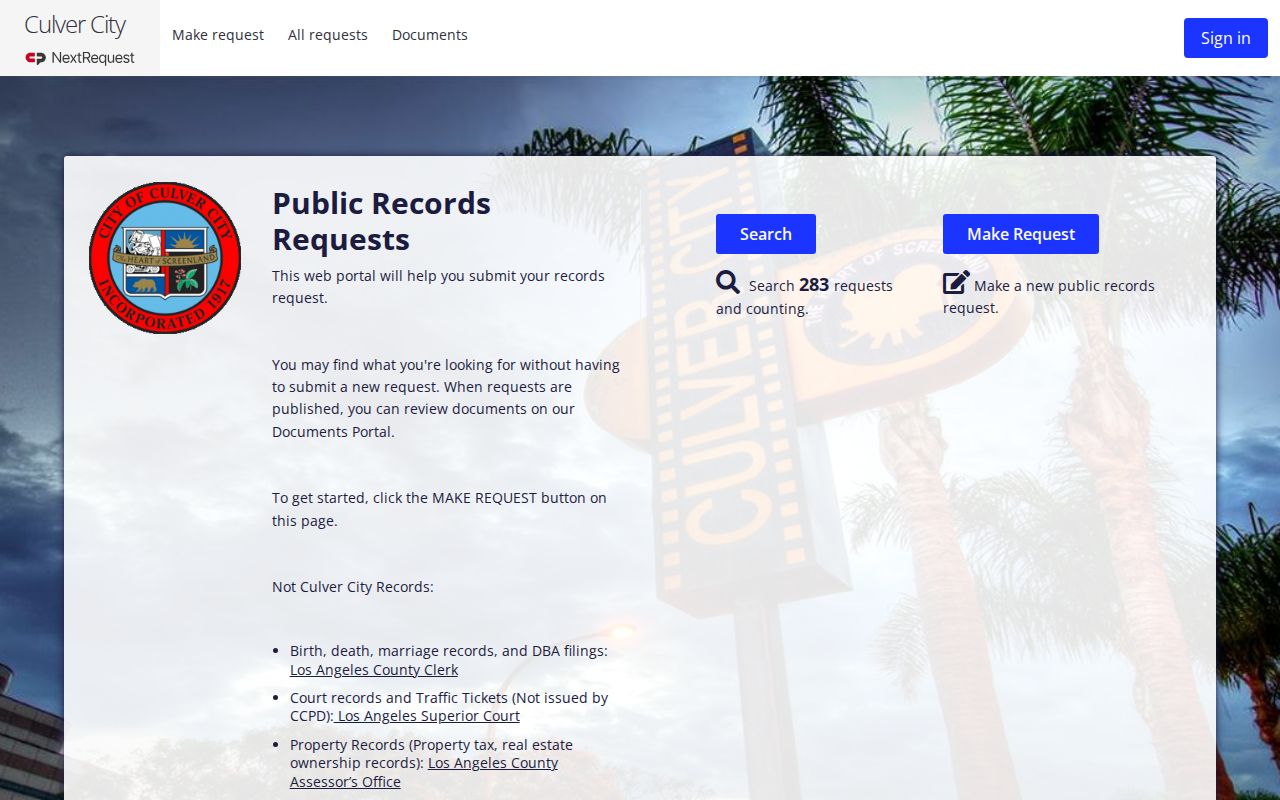
The portal matters because published documents may answer a request without a new submission, while a new request creates a reference number for tracking.
Culver City Records Offices and Portals
The right office depends on who created the record. Culver City City Hall is the municipal source for local agency records. Los Angeles County RR/CC is the recorder, county clerk, vital-record, and election hub. The Assessor handles parcel and assessment data. Los Angeles Superior Court keeps case records, while the Police Records Unit handles city police reports that are releasable under California law.
LA County Recorder Access for Culver City Records
The recorder system is the most important quirk for Culver City property research. Los Angeles County says it maintains real-estate records from 1851 forward, but it also says it does not provide internet access to real-estate records or indexes. The official reason is protected-address risk under the county’s legal advice. That means a deed name search often starts with an Assessor parcel or address clue, then moves to Norwalk, a mail search, or a copy request.
At Norwalk, records from 1851 through 1957 are available on the lower level, and records from 1958 to the present are available on the second floor. The index is alphabetical by name and year recorded. The office does not accept telephone requests for index searches, so a requester needs enough detail to use the counter, an appointment, or a mailed search request.
| Field Label | Type | Required | Format Notes |
|---|---|---|---|
| Name | Text | Yes for name index | Alphabetical by name and recording year |
| Recording year or date | Year/date | Needed for an efficient search | Mail search fee is per name and per year |
| Document number | Text | No | Best copy key when already known |
| Book/page | Text | No | Useful for older records |
| Property address or legal description | Text | No | Use with Assessor AIN and deed chain work |
| Copy type | Choice | Yes for copies | Plain or certified |
The LA County RR/CC fee page lists copy charges and the mailed search fee used for real-estate record requests.
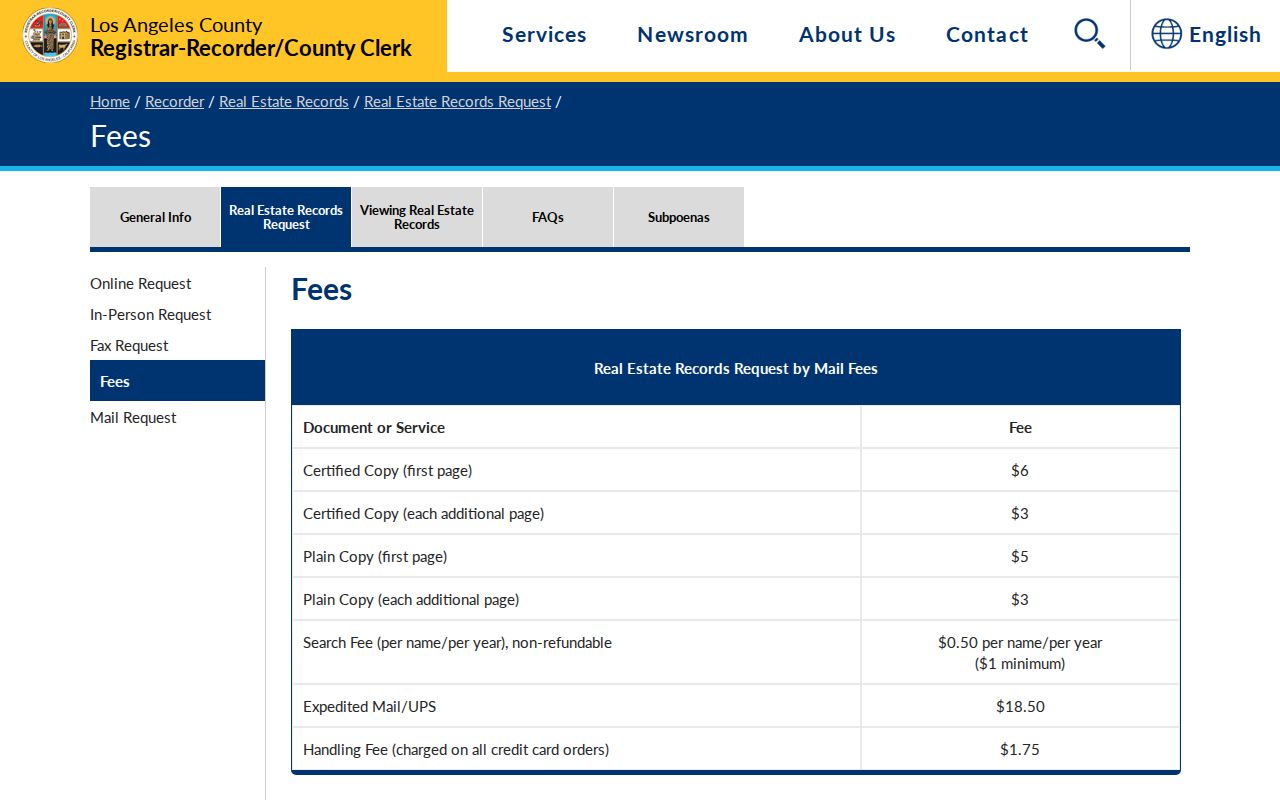
Those fees are a practical check on deed-copy solicitations: official plain and certified copies cost far less than many private mailers imply.
Culver City Property Records and GIS
Property records connect a Culver City address to a parcel, and the parcel key is the Assessor Identification Number. The Assessor Portal supports AIN and address searches, while the county map viewer shows parcel boundaries and reference layers. The public portal can show the situs address, assessed values, property characteristics, legal description data, and map links when available.
A situs address is the physical property location. A mailing address is where tax or assessment mail goes, and it may point to a trust, business entity, estate, or nonresident owner. When online ownership details are limited, the next step is not a guess. Use the parcel clue to request the recorded deed through RR/CC or request Assessor records through the proper public-record channel.
Culver City permit records add the city layer. The Building Safety Permits page says the online portal can file building, demolition, mechanical, electrical, and plumbing applications, pay fees, check permit and inspection status, respond to plan-check corrections, and search permit history. Existing building permit questions can also go to Building and Safety at (310) 253-5800 or building.safety@culvercity.org.
Definition check. AIN means Assessor Identification Number, the parcel key used to move between assessment, map, tax, and deed records.
Los Angeles Court Records for Culver City
Culver City court files are handled by the Superior Court of California, County of Los Angeles. The online system is useful but not fully free. Criminal defendant-name searches return a case number, defendant name, filing date, and filing location. Civil, family, probate, and small claims name searches return litigant name, case type, filing date, filing location, and the count of document images available for purchase.
Coverage varies by case type. Felony criminal name searches run from 1980 to present, and misdemeanor searches run from 1988 to present, with some older automated data. Family law, probate, and unlimited civil coverage starts in 1983, limited civil in 1991, and small claims in 1992. Older records may require Archives or a courthouse visit.
| Search Field | Use | Notes |
|---|---|---|
| Last name | Party or defendant name | Required for name searches |
| First name | Narrows common names | Recommended |
| Company name | Business party search | Used in non-criminal case searches |
| Filing date range | Narrows criminal searches | Helpful when a name is common |
| Case number | Summary or document access | Use after the name index returns the number |
| Guest or account payment | Paid search and images | Required for many online services |
The LASC online-services help page is the source for coverage dates, returned fields, paid searches, and document-image rules.
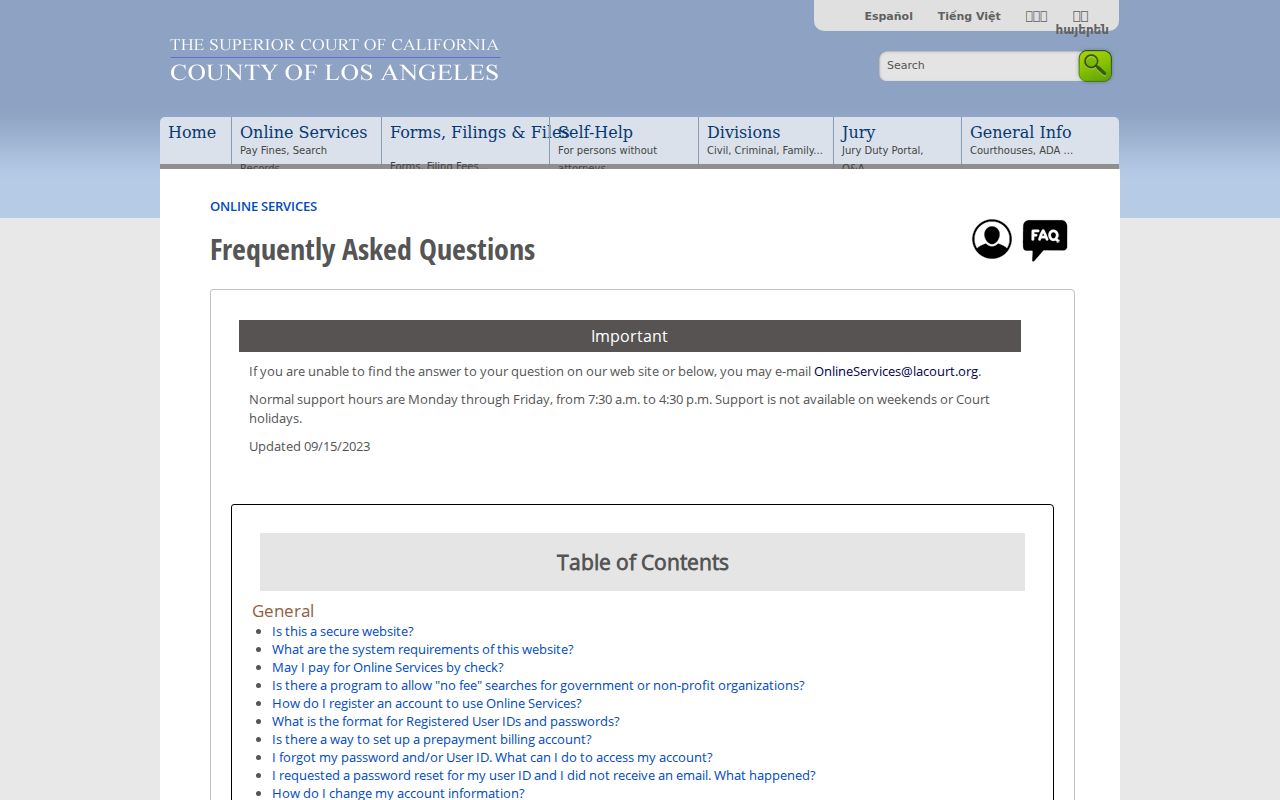
Courthouse public-access computers may provide access routes that differ from paid web searches, especially when a case needs more than an index result.
Vital Records for Culver City Events
Birth, death, and marriage copies for Culver City events run through Los Angeles County RR/CC, Los Angeles County Department of Public Health for some birth and death services, or CDPH-VR for statewide copies. California does not use a simple rule that all older birth records become fully open after a set number of years. Health and Safety Code §103526 limits authorized certified copies to eligible people.
Other requesters may receive informational certified copies when allowed. Those copies are marked as informational and are not valid for identity. The distinction matters for family history, estate files, and personal record repair, because a copy that helps confirm an event may not serve the same legal role as an authorized certified copy.
| Birth copy | LA County fee listed in the research is $34; eligibility controls authorized copies. |
|---|---|
| Death copy | LA County fee listed in the research is $26. |
| Public marriage copy | LA County fee listed in the research is $19. |
| Confidential marriage | Restricted to the parties or court order. |
| Mail address for birth requests | Registrar-Recorder/County Clerk, Birth, Death and Marriage Records Section, PO Box 489, Norwalk, CA 90651-0489. |
The LA County vital-record application shows the county request path for birth, death, and marriage records.
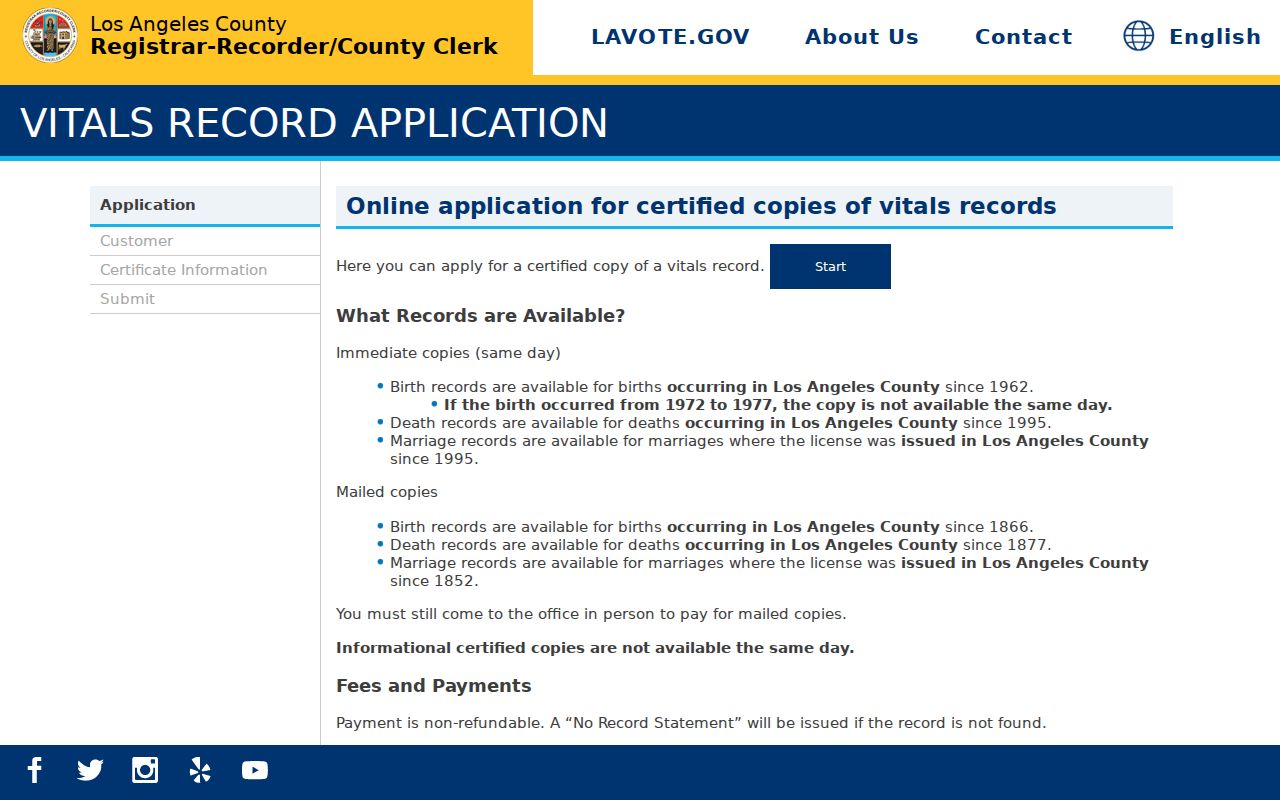
Use the county route when the event is in Los Angeles County and speed matters; statewide CDPH-VR processing can take longer.
Culver City Police and Custody Records
The Culver City Police Records Unit accepts police-report requests by email, phone, or in person. The unit lists weekday hours, the Records phone number (310) 253-6119, email policerecords@culvercity.org, and the Duquesne Avenue address. A police report is not a general name directory. Release depends on the requester’s role, the event, privacy rules, and exemptions for sensitive or active matters.
Custody records can move outside the city. Arrests booked into county custody may appear in the Los Angeles County Sheriff’s Department Inmate Locator, which uses name and date-of-birth fields. State prison custody is searched through the CDCR inmate locator. Public sex-offender notification data is handled through California Megan’s Law, which carries its own use warnings and legal limits.
For a city incident report, start with the Police Records Unit. For current custody, search LASD first, then CDCR or federal systems only if the case has moved beyond county custody.
Culver City Business Filing Records
Business filings can identify an owner, registrant, secured party, or agent tied to a Culver City address. Los Angeles County’s fictitious business name open-data portal covers current FBN statements from February 2024 forward. California Secretary of State bizfile searches show entity records, while the UCC search can surface financing-statement abstracts tied to a debtor or secured party.
The California SOS UCC search is one statewide filing path that can support a business-record trail.
UCC results are not proof of ownership of real property, but they can connect names, business entities, and lien-notice records.
The LA County FBN open-data portal is the county route for recent fictitious business name statements.
FBN records are most useful when a trade name, ZIP code, city, or filing date can narrow the result set.
Request Culver City Public Records
A good request names the custodian, describes existing records, and gives enough date, address, case, permit, or person context to let staff search. Use CPRA for city records, Assessor data requests, police reports, permit history not found online, and local agency records that are not already posted. Use a specific court, recorder, or vital-record copy process when a special statute or fee schedule controls the record.
- Identify the custodian. Use the city for municipal records, RR/CC for recorded and county-clerk records, LASC for court files, and the Assessor for parcel data.
- Check the public portal first. Look for posted NextRequest documents, Assessor parcel results, court index results, or existing county forms.
- Write a narrow request. Include dates, names, addresses, permit numbers, case numbers, document numbers, or AINs when known.
- Submit through the documented channel. Culver City accepts portal, email, mail, and in-person requests; RR/CC and vital records also use mail and copy forms.
- Track the response. Watch for a 10-day determination, any written 14-day extension, fee notice, copy eligibility issue, or exemption explanation.
- Revise if needed. Narrow broad wording, ask for non-exempt portions, or use the office’s copy order process when the record is identified.
Lawful use. Culver City public records are for lawful personal, civic, family-history, property, and verification research. Do not use a record to stalk, harass, threaten, or harm any person.
Culver City Records Fees and Limits
Fees depend on the record type. CPRA fees generally track direct duplication or statutory charges. RR/CC real-estate copies have separate plain, certified, page, mail-search, expedited, and payment handling fees. Vital records use fixed county copy fees. LASC online services can charge for name searches and document images, while courthouse terminals may be the better route when a web result is incomplete.
For RR/CC real-estate requests, the research lists $5 for the first plain-copy page and $3 for each additional page, $6 for the first certified-copy page and $3 for each additional page, and a mailed search fee of $0.50 per name per year with a $1 minimum. Expedited mail and card handling have separate charges. Checks are payable to Registrar-Recorder/County Clerk when that office requires them.
- Index
- A search tool or book that points to a record, often by name, date, or number.
- Image
- A scanned or digital copy of the document itself.
- Certified copy
- An official copy accepted for legal uses when the requester is eligible and the record type allows it.
- Custodian
- The agency that keeps the record and decides access under the law.
- Exemption
- A legal reason an agency may withhold all or part of a record.
Privacy Boundaries in Culver City Records
California privacy rules shape access to Culver City records in several ways. Safe at Home provides a substitute mailing address and confidentiality protections for qualifying participants. Confidential voter registration routes can shield residence information for protected voters. The recorder’s lack of an official internet real-estate index reflects the county’s concern that protected addresses may appear inside recorded documents.
Voter registration information is not a normal CPRA directory. California law limits voter-file access to approved election, scholarly, journalistic, political, or governmental purposes, and voter misuse can carry penalties. Vital records also have a public-information split, with authorized certified copies limited by eligibility rules and informational copies available for some non-identity uses.
The practical rule is simple: use official channels, expect redactions where privacy law applies, and verify important findings with the office that keeps the record.